1. Know and improve your soil | 40 mins
Soil Ph
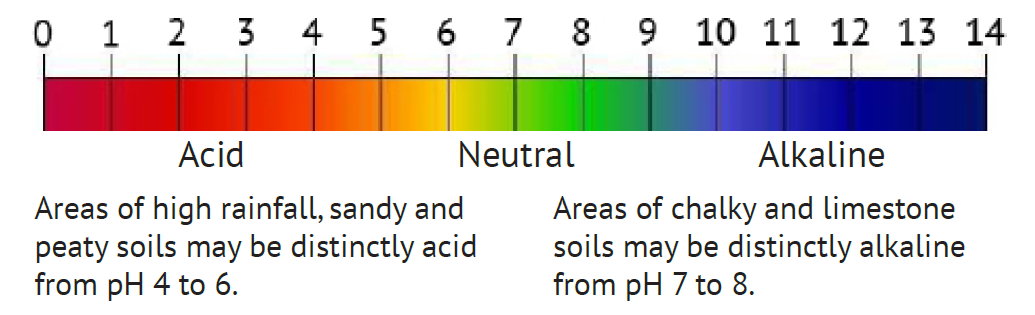
pH is the measurement of the acidity/alkalinity level of the soil. Knowing your soil pH helps you decide which plants will grow successfully, or what you need to do to increase productivity. Soil testing kits are easily available and all use a scale of 1 to 14, with the neutral point at 7. A pH of between 1 to 6 indicates an acidic soil and 8 to 14 alkaline.
Most vegetable crops will grow optimally in the range 6– 7.5 and fruit between 6 – 6.5 which is the range where most plant nutrients are most freely available. Organic growing methods help to stabilise the soil pH by the addition of composts and organic matter, and the fact that acidifying nitrogen fertilisers are not used.
Lime and Liming
 It is best organic practice to work with the soil you have. If, however, your pH is outside the range of 6.5 - 7, then you can make some adjustments. Very acidic (low pH) soils can be adjusted by applying lime. Chalky soils (high pH) will benefit from plenty of compost not just to restore deficiencies in nutrients, but also to improve the soil structure.
You should only alter pH if necessary and only minor shifts are possible. If you need to raise the pH of your soil, occasional application of ground limestone and dolomitic limestone (also contains magnesium) are the organic gardener’s choice. Their action is much slower and gentler than gardener’s lime. They are best applied in the autumn, at a rate of around 250g/sq. m (8oz\sq. yd). If the soil is very acid, another application may be needed the following year but measure pH first. The full effect is felt in the second year. Liming an acid soil will help to make certain plant foods more available, and to speed up the decay of thatch on a lawn.